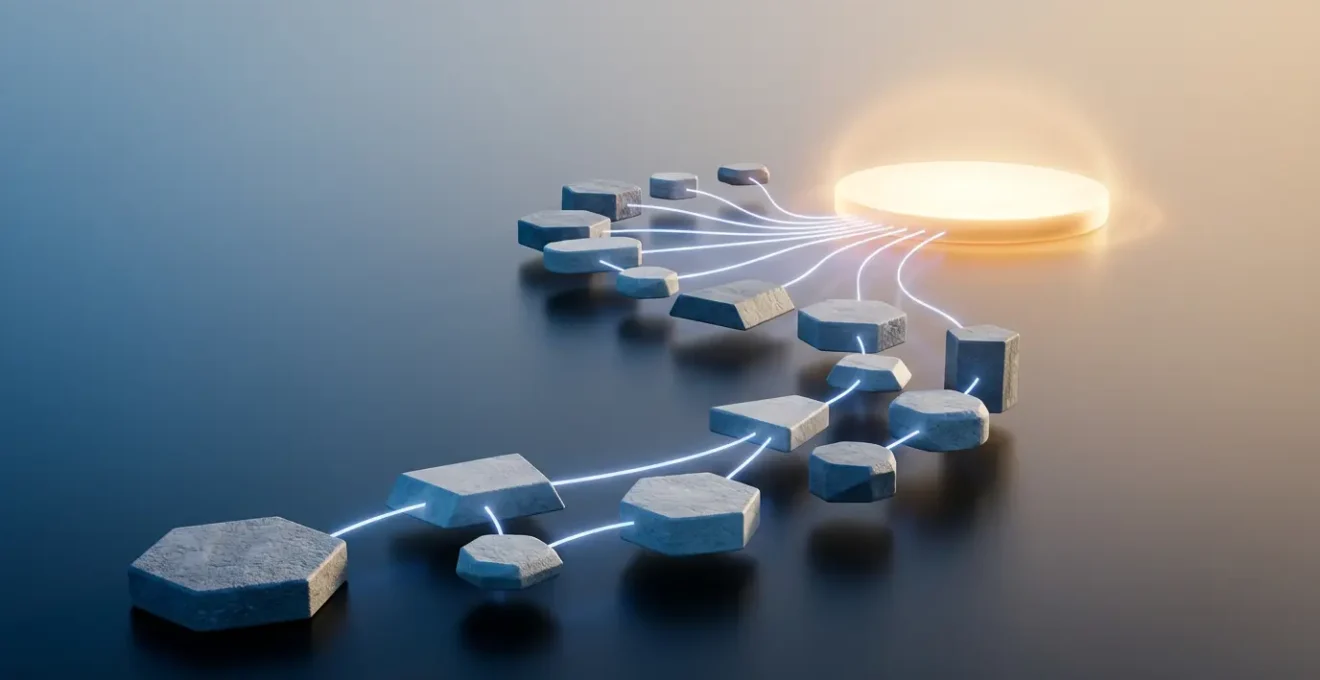
The biggest conversion leaks aren’t on your pages; they’re in the disconnected gaps *between* them.
- Disconnected customer journeys cause nearly 70% of users to abandon their goals, representing a massive loss of potential revenue.
- Optimising the checkout process alone, a notorious friction point, can increase conversion rates by over 35%.
Recommendation: Stop optimising touchpoints in silos. Instead, map the complete customer journey to identify and eliminate friction, orchestrating a cohesive flow from first contact to final conversion.
You’ve polished the homepage until it shines. You’ve A/B tested button colours and optimised your ad copy. Yet, a significant portion of your potential customers still vanish before converting, and the needle on your overall conversion rate barely moves. This is a common frustration for digital experience managers who are told to focus on creating an « omnichannel strategy » or to « map the customer journey » without a clear, actionable plan. The advice often leads to beautifully designed individual assets that fail to work together.
But what if the real problem isn’t the touchpoints themselves, but the jarring, disconnected gaps between them? What if the friction a user feels when moving from a social media ad to your app, or from an email promotion to your checkout, is the primary source of your conversion leakage? This guide moves beyond the platitude of polishing individual pages. It’s about adopting the mindset of a journey orchestrator—a strategist who maps, measures, and mends the entire digital pathway a customer travels.
We will deconstruct the anatomy of a broken journey, providing a clear methodology to identify its weak points. We’ll show you how to map your entire digital ecosystem, prioritise the most critical fixes, and implement a testing strategy that delivers meaningful, holistic improvements. The goal is not just to make each touchpoint better, but to make the journey between them seamless, coherent, and highly converting.
This article provides a comprehensive framework for transforming your fragmented digital interactions into a unified, high-performance customer journey. The following summary outlines the key stages we will cover, from diagnosing the problem to building a fully orchestrated omnichannel plan.
Summary: A Strategic Guide to Touchpoint Orchestration
- Why 70% of Customers Abandon Journeys That Cross 3+ Disconnected Touchpoints?
- How to Map Every Customer Touchpoint in Your Digital Ecosystem in One Day?
- Should You Optimise Homepage, Checkout, or Email Confirmation Pages First?
- The Touchpoint Mistake That Polishes the Homepage While Checkout Loses 60% of Users
- Should You A/B Test Touchpoints Sequentially or Run Simultaneous Experiments?
- How to Map Your Customer Journey Across 7 Touchpoints in 3 Days?
- How to Set Up Conversion Tracking Across 5 Channels in One Afternoon?
- How to Build an Omnichannel Marketing Plan That Increases Conversions by 40%?
Why 70% of Customers Abandon Journeys That Cross 3+ Disconnected Touchpoints?
The core reason for high abandonment rates in multi-channel journeys is friction. Every time a customer moves from one touchpoint to another—from an email link to a landing page, from a social ad to an app store, from a product page to checkout—there is a risk of a disconnect. This could be an inconsistent message, a different design, a request for information they’ve already provided, or a broken user flow. Each point of friction adds cognitive load and erodes trust, pushing the customer closer to abandonment.
The data paints a stark picture of this phenomenon. While the specific « 70% across 3+ touchpoints » is a conceptual illustration of a well-documented problem, the overall abandonment rates confirm the scale of the issue. For ecommerce, the average cart abandonment rate is a staggering 70.22% based on an average of 49 different studies. This isn’t just about a poorly designed cart; it’s the culmination of every small friction point that came before it. When the journey feels clunky, the final commitment is the first thing to be sacrificed.
Conversely, a connected experience yields significant rewards. A successful omnichannel campaign by Marriott found that customers who saw ads across multiple connected channels were 1.8 times more likely to visit their website. The campaign, which focused on a cohesive cross-channel message, resulted in a 45% increase in conversion rate. This demonstrates a fundamental truth: customers reward businesses that respect their journey and provide a seamless, orchestrated experience rather than a series of isolated and disjointed interactions.
Ultimately, a disconnected journey tells the customer you don’t fully understand their needs. By focusing on orchestrating a cohesive flow, you are not just optimising for conversion; you are building a foundation of trust and demonstrating a deep respect for the customer’s time and attention.
How to Map Every Customer Touchpoint in Your Digital Ecosystem in One Day?
Mapping your entire digital ecosystem seems like a monumental task, but it can be kickstarted effectively in a single, focused day. The key is not to achieve perfection immediately, but to create a comprehensive « Version 1.0 » that identifies the most critical pathways and potential friction points. This is best achieved through a collaborative workshop involving key stakeholders from marketing, sales, customer service, and product teams. Each department holds a unique piece of the customer puzzle.
The goal of the workshop is to collaboratively build a visual map of all the places customers interact with your brand. This process uncovers hidden touchpoints and highlights the often-overlooked handoffs between channels, which are prime locations for conversion leakage. The visual nature of this exercise makes abstract concepts tangible and fosters a shared understanding across teams.
As you can see, the act of mapping is a dynamic and human-centric process. It’s about bringing diverse perspectives together to trace the real, often messy, paths your customers take. To structure this activity, you can follow a clear framework to guide your one-day session.
Action Plan: The One-Day Touchpoint Mapping Framework
- Persona Definition: Start by agreeing on the 1-2 primary customer personas you are mapping for. Who are they and what is their main goal?
- Journey Scaffolding: Outline the high-level stages of the customer journey (e.g., Awareness, Consideration, Purchase, Service, Loyalty) on a large whiteboard or digital canvas.
- Touchpoint Brainstorm: Have each department list all the touchpoints they manage or are aware of for each stage. Go wide and capture everything from social media ads and blog posts to error messages and packaging inserts.
- Path-finding: Connect the dots. Trace the most common pathways customers take between these touchpoints. Identify the primary « handoffs » between channels (e.g., from an Instagram ad to a product page). This is where you’ll find the friction.
- Friction Highlighting: For each handoff, ask: « What could go wrong here? Is the message consistent? Is the transition seamless? » Use red sticky notes to mark these potential friction points.
By the end of the day, you will not have a perfect map, but you will have something far more valuable: a shared, cross-functional understanding of your customer’s journey and a prioritised list of the most critical friction points that need immediate attention.
Should You Optimise Homepage, Checkout, or Email Confirmation Pages First?
This is a classic prioritisation dilemma for digital experience managers. With limited resources, where should you focus your optimisation efforts first? While the homepage is the « front door » and post-purchase emails build loyalty, the data overwhelmingly points to one area as the single greatest point of leverage for immediate conversion impact: the checkout process. It is the final hurdle, and it is where the most money is left on the table.
The reason is simple: at the checkout stage, you are dealing with users who have already shown high intent. They’ve browsed, selected, and decided to buy. Losing them at this stage is a catastrophic failure of the user experience. Research consistently shows this is a massive leak in the conversion funnel. For example, a common reason for abandonment is being presented with unexpected costs at the final step; data reveals that 48% of users abandon carts because extra costs like shipping and taxes were too high.
Fixing these issues has a disproportionately large impact. A smoother checkout design, clearer cost presentation, and a reduced number of form fields can make a dramatic difference. According to extensive testing, the design and flow of a checkout process can be so influential that a well-designed checkout can lead to a potential conversion rate increase of 35.26%. This is not a marginal gain; it’s a transformational lift that you are unlikely to achieve by simply tweaking homepage copy or a welcome email.
Therefore, the strategic answer is clear. While all touchpoints matter, your first optimisation sprint should be a ruthless, data-driven attack on every point of friction within your checkout flow. Secure the final, most critical step of the journey first, and then work your way backwards to optimise the paths that lead to it.
The Touchpoint Mistake That Polishes the Homepage While Checkout Loses 60% of Users
The most common and costly mistake in digital experience management is the « Vanity First » approach: pouring immense resources into perfecting high-visibility, top-of-funnel touchpoints like the homepage while neglecting the high-friction, bottom-of-funnel mechanics of the checkout. It’s the digital equivalent of having a stunning, award-winning lobby in a hotel where the payment systems are constantly broken. It impresses visitors but fails the customers who are ready to pay.
This happens because homepage metrics are often visible, public-facing, and easy to present to leadership. Bounce rate and time-on-page feel like a measure of success. However, a beautiful homepage doesn’t guarantee a conversion if the journey breaks down later. The real damage occurs in the less glamorous, but far more critical, stages of the funnel. The checkout process, especially on mobile devices, is a notorious black hole for conversions.
The context of the user’s device dramatically amplifies this problem. A checkout flow that is merely inconvenient on a desktop can become completely unusable on a smaller screen with a less stable connection. This is not a minor issue; recent data shows that the mobile cart abandonment rate is 77.06%, significantly higher than on desktop. This massive leakage often goes unnoticed by teams who are overly focused on their desktop homepage analytics. They polish the front door while customers are fleeing out the back window on their phones.
The remedy is a change in perspective. A true journey orchestrator looks beyond the vanity of the homepage and dives deep into the analytics of the checkout flow, broken down by device. They ask the hard questions: Where is the friction most acute? Where are we losing the customers who are closest to converting? The answer, more often than not, is in the final, often-neglected steps of the mobile checkout.
Should You A/B Test Touchpoints Sequentially or Run Simultaneous Experiments?
Once you’ve identified friction points, the natural next step is to test improvements. However, a common question arises: should you test changes on different touchpoints one by one (sequentially), or can you run multiple experiments at the same time (simultaneously)? The answer, as any experienced consultant will tell you, is « it depends. » The wrong choice can invalidate your results, leading you to make poor business decisions based on corrupted data.
The core issue is the risk of interaction effects. This occurs when the outcome of one experiment is influenced by another experiment running at the same time. For example, if you are simultaneously testing a new ad campaign (touchpoint A) and a new landing page design (touchpoint B), you won’t know if a lift in conversions came from the new ad, the new page, or the specific combination of the two. This clouds your data and makes it impossible to draw clear conclusions.
The strategic choice between sequential and simultaneous testing depends on the degree of overlap between the experiences you are testing. A disciplined framework is needed to decide which approach to take in order to maintain data integrity while maximising testing velocity.
As the visual representation suggests, these are two fundamentally different paths to insight. Your decision framework for A/B testing should include the following strategies:
- Run Simultaneously When No Overlap Exists: If you are testing two completely independent parts of the journey (e.g., the checkout flow and the « About Us » page), you can run experiments concurrently without significant risk of interaction.
- Run Sequentially When Overlap is Unavoidable: If two touchpoints directly influence each other (e.g., the product list page and the product detail page), you must test them sequentially to isolate the impact of each change. Test A, conclude, then Test B.
- Use Mutual Exclusivity for Overlapping Tests: A more advanced method is to run simultaneous tests but divide your traffic. Group 1 sees only the test on touchpoint A. Group 2 sees only the test on touchpoint B. This prevents users from being exposed to both experiments, eliminating interaction effects but requiring more traffic.
- Implement a Prioritisation Roadmap: When sequential testing is necessary, use a framework like ICE (Impact, Confidence, Ease) to decide the order of your tests, tackling the highest-potential experiments first.
Ultimately, a mature testing program uses a hybrid approach. It runs non-overlapping tests simultaneously to increase velocity, while carefully sequencing or isolating tests that could influence one another. This balance of speed and rigour is the hallmark of effective journey orchestration.
How to Map Your Customer Journey Across 7 Touchpoints in 3 Days?
While a one-day workshop is great for a high-level overview, a more focused, in-depth map can be created with a « 3-Day Sprint » methodology. The goal isn’t to map every single possible interaction, but to deeply understand a few of the most valuable and common journeys your customers take. This prioritised approach delivers actionable insights much faster than a months-long, all-encompassing project.
The sprint focuses on a cross-functional team that dedicates three days to a specific, high-value journey, such as ‘First-Time Buyer on Mobile’ or ‘Returning Customer Reactivation’. By narrowing the scope, the team can move beyond a simple list of touchpoints and dig into the emotions, motivations, and pain points experienced by the customer at each stage. This adds a crucial layer of qualitative insight to your quantitative data.
The 3-day structure provides a clear, time-boxed process for moving from ambiguity to a prioritised action plan:
- Day 1: Identify and Scope the Journey. The first day is about alignment. The team selects the 1-2 most critical customer journeys to focus on, based on business value and known pain points. They define the specific persona, their goal, and the start and end points of the journey. This tight scope prevents the project from becoming unwieldy.
- Day 2: Outline Phases and Touchpoints. On the second day, the team maps out the key phases of the chosen journey (e.g., Awareness, Consideration, Decision, Retention, Advocacy). Within each phase, they list all the touchpoints the customer interacts with, both online and offline. This creates the structural skeleton of the journey map.
- Day 3: Conduct Friction Analysis and Plan Action. The final day is for analysis and action. The team goes through the map, touchpoint by touchpoint, identifying pain points, inconsistencies, and moments of frustration (the friction). They then brainstorm solutions and create a prioritised backlog of specific, actionable tasks to address the most significant issues.
The outcome of the 3-day sprint is not a perfect, exhaustive document. It is a powerful, focused tool that has team buy-in and is directly linked to a concrete action plan. This is how you move from mapping to making a real difference in the customer experience.
How to Set Up Conversion Tracking Across 5 Channels in One Afternoon?
The promise of setting up comprehensive, cross-channel tracking in a single afternoon can seem unrealistic, but it’s achievable if you focus on a « minimum viable setup » using modern analytics platforms. The goal is not to track every conceivable metric, but to establish a foundational layer of tracking that connects your most important channels and conversion events. This allows you to start seeing the connections in your customer’s journey immediately.
The key is to centralise your tracking logic using a tool like Google Tag Manager (GTM). Instead of manually adding tracking snippets to each platform, you manage them all from one central dashboard. This allows you to define a conversion event once (e.g., a « form submission » or « purchase completed ») and then send that event data to all relevant platforms like Google Analytics, your ad platforms (Google Ads, Facebook Ads), and other marketing tools.
Case Study: IBM’s Cross-Channel Tracking Implementation
A prime example of this in action is IBM. They effectively map their customer journey by leveraging data analytics to track user behaviours across their website, email campaigns, and social media platforms. By using centralised systems like Google Analytics and their CRM, they can gather and connect data on how customers engage at each touchpoint. This unified view allows IBM to understand the complete journey and optimise their marketing efforts to better serve clients, proving the immense practical value of a centrally managed tracking strategy.
This approach transforms tracking from a fragmented, developer-dependent task into a streamlined, marketing-led function. You gain the ability to see, for example, how many users who clicked a specific Facebook ad eventually converted after receiving an email three days later. This is the first step toward true journey orchestration, as you can finally measure the influence that different touchpoints have on each other.
While a truly sophisticated attribution model takes time to build, establishing this core cross-channel tracking framework in an afternoon is entirely possible. It provides the initial layer of data needed to move beyond single-channel optimisation and start managing the entire customer journey.
Key Takeaways
- The most significant conversion losses occur in the ‘gaps’ between touchpoints, not necessarily on the pages themselves.
- Prioritise optimising the checkout process; it’s the highest-friction, highest-impact area where gains of over 35% are possible.
- True omnichannel success comes from orchestrating a cohesive journey, which consistently outperforms a strategy of optimising isolated touchpoints.
How to Build an Omnichannel Marketing Plan That Increases Conversions by 40%?
Building a true omnichannel marketing plan goes far beyond simply being present on multiple channels. A multichannel plan uses many channels; an omnichannel plan makes those channels work together as a single, unified experience. It is this touchpoint cohesion that unlocks significant conversion lifts. The focus shifts from channel performance to customer journey performance.
An effective omnichannel plan is built on the foundation of the journey maps and cross-channel tracking we’ve discussed. It uses the insights from these tools to create a consistent, personalised, and context-aware conversation with the customer, regardless of how they choose to interact. This means the message they see in a social media ad is reinforced in the email they receive and is reflected on the landing page they visit. This consistency builds trust and reduces the cognitive friction that leads to abandonment.
Case Study: Danone’s Omnichannel Proves Superiority
Danone’s Actimel brand put this to the test with a head-to-head A/B test comparing their traditional multichannel approach against a fully orchestrated omnichannel strategy. The results were definitive. The omnichannel approach, which coordinated messaging and targeting across channels, delivered a 1.3x higher conversion rate and reduced the customer’s time-to-purchase by 11%. Furthermore, the cohesive strategy attracted 9% new-to-brand buyers, proving its power in both conversion and acquisition. This case study provides clear, quantitative proof that connected touchpoint strategies significantly outperform siloed approaches.
This superior performance is not an anomaly. When customers experience a truly unified brand journey, their engagement and spending habits change. According to the study conducted for Danone, the omnichannel campaign even achieved a 7-point lift in brand perception, demonstrating that a good journey is also good branding. This creates a virtuous cycle where a better experience leads to higher conversions and a stronger brand, which in turn makes future marketing efforts more effective.
To begin building your omnichannel plan, start small. Select one critical customer journey and focus on orchestrating the three most important touchpoints within it. Measure the impact, learn from the results, and then scale the strategy to other journeys. This iterative approach is how you transform your marketing from a series of disconnected shouts into a single, compelling conversation that drives real business growth.