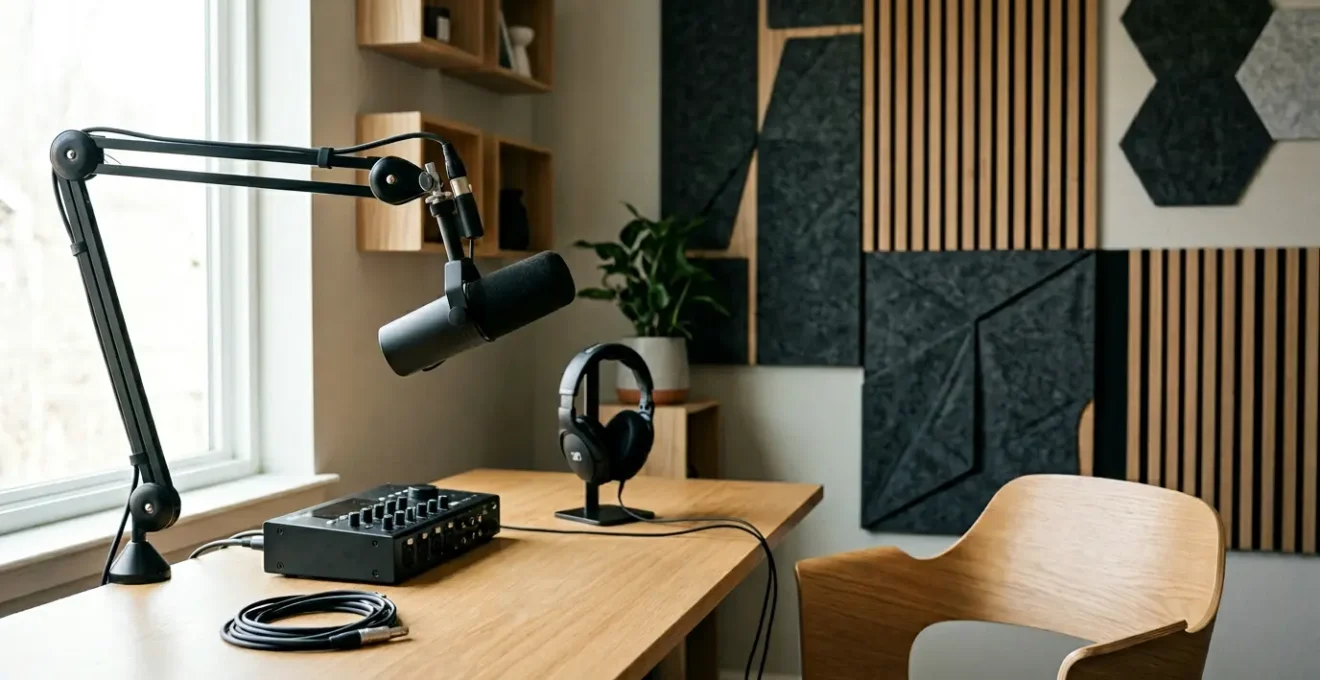
Growing a podcast to 10,000 listeners isn’t about expensive gear or luck; it’s about implementing a repeatable ‘Audio-First Production System’.
- Success hinges on respecting listener intimacy and designing content that feels personal and immersive.
- An efficient, four-hour weekly workflow and a strategic approach to video repurposing are key to sustainable growth.
Recommendation: Shift your focus from simply recording content to designing a complete system that turns listeners into loyal fans.
For UK content marketers, launching an on-demand audio series feels like a brilliant move. The goal is ambitious but clear: build a loyal audience, establish thought leadership, and hit that coveted 10,000-listener milestone. Yet, the reality for many is a mix of excitement and paralysis. You’re a brand manager or marketer, not an audio engineer. The path seems littered with technical jargon, complex production workflows, and the daunting challenge of building an audience from scratch.
The common advice often misses the point. You’re told to « buy a good microphone » or « just be consistent, » but this overlooks the core strategic challenge. It’s not about the gear; it’s about the system. The fear isn’t just about sound quality; it’s about sinking hundreds of hours into a project that never finds its audience, another branded podcast fading into the vast sea of digital noise. This is a legitimate concern, especially when you see the sheer volume of content being produced daily.
But what if the key wasn’t in producing more, but in producing smarter? What if the secret to reaching 10,000 listeners wasn’t about chasing viral trends, but about building a deep, measurable connection with a core audience first? The solution lies in adopting an Audio-First Production System. This is a strategic framework that treats listenership as a metric of intimacy, not just reach, and builds everything—from episode format to video repurposing—around a repeatable, efficient process. It’s time to stop thinking like a broadcaster and start thinking like a system designer.
This guide will walk you through the essential components of that system. We’ll deconstruct why audio creates such powerful engagement, lay out a practical production schedule, and explore the strategic decisions that turn a simple recording into a powerful content engine. Let’s get stuck in.
Summary: An Audio-First System for Audience Growth
- Why Podcast Listeners Are 4x More Engaged than Blog Readers?
- How to Produce a Professional Podcast Episode in 4 Hours per Week?
- Interview Series or Solo Episodes: Which Podcast Format for B2B Thought Leadership?
- The Podcast Mistake That Loses 80% of Listeners After Episode 3
- When to Seek Podcast Sponsors: 1,000, 5,000, or 10,000 Downloads per Episode?
- How to Tell if Your Content Is Experiential or Just Informative?
- How to Produce 5 High-Quality Video Clips per Week With 6 Hours of Work?
- How to Create Engaging Video Clips That Generate 10x More Views in 3 Seconds?
Why Podcast Listeners Are 4x More Engaged than Blog Readers?
The claim that podcast listeners are more engaged isn’t just marketing fluff; it’s rooted in the unique psychology of audio consumption. Unlike a blog post, which is often scanned on a screen amidst a dozen other open tabs, audio content demands a different kind of attention. It’s an intimate medium. Research shows that 93% of podcast consumption happens on headphones, creating a direct, one-to-one communication channel. This focused listening environment makes the reception of your message twice as effective as other formats.
This intimacy translates directly into time spent. While a reader might give a blog post three to five minutes, dedicated podcast listeners invest significantly more. They actively choose to spend their commute, their workout, or their quiet evening hours with your brand’s voice in their ears. It’s not uncommon for them to spend nearly seven hours per week listening to shows. This isn’t passive consumption; it’s a deliberate act of inviting a brand into their personal space. This level of access is unparalleled in most other forms of content marketing.
For a UK content marketer, this changes the game. You’re not just competing for clicks or views; you’re competing for a share of someone’s dedicated listening time. Success isn’t just about reaching a large number of people, but about building a relationship so strong that they choose to spend hours with you. This is why we must treat downloads not as a vanity metric, but as an intimacy metric. Each download represents a listener trusting you with their time and attention in a deeply personal way, a connection far stronger than a fleeting page view.
How to Produce a Professional Podcast Episode in 4 Hours per Week?
The fear of an endless production cycle is what stops many brilliant branded podcasts from ever being made. The key isn’t more hours; it’s a smarter workflow. A professional-sounding episode doesn’t require a Hollywood budget, but it does demand a repeatable system. By treating production like an assembly line, not an art project, you can consistently create high-quality audio in just four hours per week.
The goal is to eliminate decision fatigue and minimise context switching. This means batching tasks and using templates for everything. Your audio editor (like Audacity, Descript, or Adobe Audition) should have a pre-built project file with your intro/outro music, labeled tracks for host and guest, and your standard audio processing effects (EQ, compression) already saved. This way, you’re not rebuilding the episode from scratch every single time. You’re simply dropping in new content.
AI tools are your secret weapon for efficiency. After recording, run the audio through a transcription service. This doesn’t just prepare a transcript for accessibility; it allows you to « edit with your eyes. » You can read the text, highlight the best takes, identify sections to cut, and create timestamps for your show notes *before* you even start the painstaking process of audio editing. This turns a long, tedious task into a focused, strategic one.
Your 4-Hour Weekly Podcast Production Plan:
- Pre-Production (Batch): Brainstorm and outline at least your first 10-12 episodes in a shared content calendar to ensure you launch with momentum and a clear content arc.
- Template Setup (One-Time): Develop a pre-built project file in your audio editor with labeled tracks, pre-set EQs for your voice, and placeholders for your regular segments.
- Efficient Recording & Editing: Record your core content in one block, then use AI transcription tools to identify key sections and create timestamps before opening the audio editor for the final polish.
- Systematic Publishing: Create a consistent publishing schedule and batch your production work (e.g., all recording on Monday, all editing on Tuesday) to avoid constant context-switching and maintain flow.
Interview Series or Solo Episodes: Which Podcast Format for B2B Thought Leadership?
Choosing your podcast format isn’t just a creative decision; it’s a core strategic choice that dictates your path to thought leadership. The two most common B2B formats, solo episodes and interview series, serve very different objectives. There is no single « best » format; the right choice depends entirely on whether your primary goal is to project authority or build a network.
Solo episodes are the most direct path to establishing your brand’s voice as the definitive authority. By delivering focused, insightful monologues, you position your host (and by extension, your company) as the expert. This format gives you complete control over the narrative and is perfect for deep dives into your unique methodologies or industry perspectives. However, it places a high burden on a single person to consistently generate compelling content.
Interview series, on the other hand, are a powerful tool for network-building, cross-promotion, and lead generation. Each guest brings their own expertise and audience, providing fresh perspectives and expanding your reach. For B2B, this format can be brilliantly repurposed as audio case studies, as demonstrated by Mitie. Their « Science of Service » podcast turned client conversations into compelling stories, and the results were staggering. The show became a proof point of their success, and from an objective of 250 downloads, they averaged 10,000 per episode, placing them in the top 10% of podcasts globally. This proves that a well-executed interview strategy can deliver both content and business results, with some B2B shows achieving a 90% average consumption rate.
Case Study: Mitie’s « Science of Service » Podcast
UK facilities management company Mitie launched a B2B podcast featuring conversations with their own clients, effectively turning case studies into engaging audio content. Their initial goal was a modest 250 downloads per episode. By focusing on genuine client stories and shared successes, they smashed their target, averaging 10,000 downloads per episode across the series. This performance placed the show in the top 10% of all podcasts globally, with two episodes even reaching the top 5%, demonstrating the immense potential of using the interview format to showcase client success.
The Podcast Mistake That Loses 80% of Listeners After Episode 3
The most common reason new podcasts fail isn’t poor sound quality or uninteresting topics; it’s a failure to respect the listener’s attention budget. Podcasting has a « three-episode problem »: if you haven’t hooked a listener by their third try, they are unlikely to return. But the damage often starts much, much earlier. The single biggest mistake that kills audience retention happens in the first few minutes of every episode: a long, self-indulgent introduction.
Listeners are incredibly impatient at the start of an episode. They’ve clicked ‘play’ with a specific promise in mind, and they want you to get to the point. Data confirms this: research on podcast consumption patterns shows that shows experience a 20-35% drop in listenership within the initial five minutes. Your job is to fight this drop-off with a compelling, concise opening.
The culprit is almost always an intro that is too long and serves the host more than the listener. Rambling updates, multiple pre-roll ads, and a lengthy, generic theme song all burn through the listener’s precious attention budget. The data is clear on this: analytics across thousands of podcasts reveal that episodes with intros exceeding 90 seconds experience nearly double the drop-off rates compared to those with focused, 30-60 second openings. The first minute is not the time for housekeeping; it’s the time to deliver on your episode’s promise.
Your intro should do three things quickly: state the episode’s topic and value proposition (the hook), briefly introduce the speaker(s), and get straight to the core content. Anything else is a potential exit ramp for a new listener. By ruthlessly cutting your intro down to its essential elements, you show respect for your audience’s time and dramatically increase the chances they’ll stick around for the valuable content that follows.
When to Seek Podcast Sponsors: 1,000, 5,000, or 10,000 Downloads per Episode?
For many brand managers, sponsorship is the ultimate validation of a podcast’s success. However, the question of *when* to seek sponsors is often misunderstood. The answer depends heavily on your definition of « sponsorship » and the size of your audience. Chasing traditional ad revenue too early can be a demoralising distraction from what truly matters: audience growth.
The world of big podcast advertising networks operates on scale. If your goal is to have programmatic, pre-roll ads from major brands inserted into your show, you need significant numbers. As a general rule, industry standards indicate that traditional ad networks look for at least 10,000-15,000 monthly downloads before they will even consider working with a show. For a new podcast, this number can feel impossibly distant, and focusing on it from day one is a recipe for frustration.
However, this doesn’t mean monetisation is impossible for smaller shows. It simply requires a more direct and strategic approach. Instead of relying on networks, you can pitch brands directly. A show with 1,000 highly-engaged listeners in a specific B2B niche can be far more valuable to an aligned sponsor than a show with 50,000 generic listeners. This is where creating a media kit, highlighting your audience demographics, and demonstrating engagement becomes crucial. Other early-stage monetisation strategies include affiliate partnerships, selling your own products or services, or using a platform for listener donations.
The path to monetisation is a tiered one, with different opportunities opening up as your audience grows. The key is to match your strategy to your current download numbers.
| Downloads per Episode | Sponsorship Opportunities | Recommended Strategy |
|---|---|---|
| Under 1,000 | Limited traditional sponsorship | Focus on audience growth, listener donations, merchandise |
| 1,000-5,000 | Some direct sponsorship opportunities | Pitch aligned brands directly, use affiliate programs |
| 5,000-10,000 | Increased interest from smaller brands | Create media kit, approach niche sponsors |
| 10,000-20,000 | Most advertising networks available | Join ad networks, negotiate CPM rates ($25-35) |
| 20,000+ | Premium sponsorship opportunities | Command premium rates, direct enterprise deals |
How to Tell if Your Content Is Experiential or Just Informative?
In the world of branded content, there’s a critical distinction between content that is merely informative and content that is truly experiential. Informative content gives you facts; a list of features, a set of instructions, a dry recitation of data. Experiential content, on the other hand, creates a feeling, paints a picture, and immerses the listener in a story or an idea. In audio, this difference is everything.
An informative podcast episode about a new software might list its five key benefits. An experiential episode would tell the story of a user whose business was transformed by one of those benefits. It would use sound design to place you in their office, let you hear the frustration in their voice before the solution, and share the relief in their voice after. The information is the same, but the delivery creates an emotional connection and makes the message far more memorable.
So, how do you measure this? How do you know if you’re creating a genuine experience? One of the most powerful—and often overlooked—metrics is the listen-through rate (LTR). This is the percentage of your audience that listens to an episode from start to finish. A low LTR suggests your content is informative but not engaging enough to hold attention. Listeners are « snacking » on the information and leaving. But a high LTR indicates you’ve created a compelling narrative. As a benchmark, podcast analytics platforms define a strong listen-through rate as typically 90% or higher. Achieving this means you’ve successfully turned a list of facts into an experience worth finishing.
The goal of your on-demand audio series should be to move beyond information and into experience. Use storytelling, vivid descriptions, sound design, and authentic human voices. Don’t just tell your audience what you want them to know; make them feel it. That is the hallmark of truly great audio content.
How to Produce 5 High-Quality Video Clips per Week With 6 Hours of Work?
In a visually-driven world, your audio content can’t afford to stay audio-only. Repurposing your podcast into video clips for platforms like YouTube, LinkedIn, and Instagram is essential for discovery. The challenge? Doing it without doubling your workload. The secret, once again, is an efficient system. You can produce a week’s worth of high-quality video clips in just six hours by adopting an « assembly line » approach.
This system treats « repurposing » not as an afterthought, but as an integrated step in your production process, which we call content extraction. The most effective podcasters plan for their video clips during the recording itself. They intentionally make concise, high-impact statements or tell short, self-contained stories, knowing these will be perfect 30-60 second clips. This turns repurposing from a search-and-discovery mission into a simple extraction process.
The justification for this effort is overwhelming. You must go where the audience is, and increasingly, that’s on video platforms. In fact, recent platform usage data reveals that one in three people in the U.S. listen to podcasts on YouTube, making it the most popular single platform. Ignoring video is like setting up a shop on a quiet side street when the main high street is just around the corner.
By batching tasks and using templates, the video creation process becomes highly efficient. You identify all clips at once, transcribe them, write all the hooks and captions in a single session, and then edit them all using a pre-built template with your brand’s fonts and colours. This assembly line stops the constant, time-wasting switching between creative and administrative tasks.
Your Assembly Line for Efficient Clip Production:
- Hour 1-2 (Identification): Review your main recording and identify all 5 clip opportunities. Use AI transcription to get timestamps and text for easy selection.
- Hour 3 (Creative Writing): Write compelling hooks and captions for all 5 clips in a single batch session. Focus on grabbing attention in the first three seconds.
- Hour 4-6 (Editing): Edit all 5 clips in one go using a pre-built video template (e.g., in Canva or Adobe Express) that includes your brand colours, fonts, and space for dynamic captions.
- Proactive Recording: During your next podcast recording, intentionally create several 30-60 second, self-contained, high-impact statements. This makes future clip ‘extraction’ effortless.
Key takeaways
- Intimacy Over Reach: Focus on the deep, personal connection audio provides. Treat downloads as a measure of trust, not just a number.
- Systemise Everything: Overcome production overwhelm with a repeatable, templated workflow for both audio and video to ensure consistency without burnout.
- Plan for Repurposing: Don’t just repurpose your content as an afterthought. Design your episodes from the start with ‘content extraction’ in mind for social video clips.
How to Create Engaging Video Clips That Generate 10x More Views in 3 Seconds?
Creating video clips from your podcast is one thing; creating clips that people actually watch is another entirely. In the fast-scrolling world of social media, you don’t have minutes to earn attention—you have seconds. The average human attention span has plummeted, and you are fighting for a fraction of it. The key to winning this battle lies in the first three seconds of your video clip.
Your clip must immediately answer the viewer’s subconscious question: « Why should I stop scrolling for this? » This is achieved with a powerful hook. A hook can be a provocative question, a surprising statistic, or a statement that challenges a common belief. It cannot be a slow fade-in with your podcast’s logo. You must deliver value or create intrigue instantly, often before the viewer has even turned on their sound. This is why dynamic, burnt-in captions are non-negotiable.
The value of cracking this code is immense, especially for B2B marketers targeting senior decision-makers. It’s a notoriously difficult-to-reach demographic, but one that is active on platforms like LinkedIn. A well-crafted video strategy can break through. One B2B brand’s influencer-driven podcast video strategy is a perfect example.
B2B Podcast Video Strategy Drives Executive Engagement
A B2B podcast marketing campaign in 2024 focused on creating high-impact video clips for social media. While the total view count was a modest 4,000, the true success was in the audience composition. Analysis revealed that an impressive 7% of the viewers were at the executive director level. By using an influencer-led approach and crafting engaging clips, the campaign successfully captured the attention of a high-value demographic that is typically shielded from traditional marketing, proving the strategic value of video clips beyond simple view counts.
This case study shows that success isn’t always about massive view counts. It’s about reaching the *right* people. By focusing your efforts on creating sharp, hook-driven video clips, you can turn your audio content into a powerful tool for engaging the exact audience your business needs to reach, proving that a few seconds of their attention can be more valuable than hours of someone else’s.
Now that you have a complete overview of the Audio-First system, from understanding listener psychology to mastering efficient production and strategic repurposing, the path to 10,000 listeners is no longer a mystery. It’s a clear, actionable roadmap. The final step is to commit to the system and start building. Evaluate your current content strategy and identify where you can begin implementing these principles today to transform your on-demand audio series into a genuine asset for your brand.